This is the statement I read to participants in the first Radical Welcome Symposium, May 23, 2025, at the Wayne Theatre – Aili Huber
Hello, and welcome to the Shenandoah Valley. I am thrilled that you are all here, and that this symposium is about to start. This is going to be a transformative weekend for all of us, and for our industry.
I want to start by giving you an orientation to the conceptual framework of the schedule and what I’m hoping we will create together.
I’m Aili Huber. I’m the founder and Artistic Director of Silk Moth Stage, as well as a frequent guest artist at Bridgewater College Theater. I work at various theaters around the country as a director, dramaturg, and educator. I like to say I go where the plays need me.
I’m also the creator of the Take 5 framework, which is a policy framework for helping theaters create more welcoming and equitable workplaces. So part of my work is visiting institutions all over the place to share about Take 5, and do policy implementation-related work.
The Background
I’ve convened this symposium because when I started developing Take 5, I really thought it was about mental health access, but as I have researched and built it, I’ve drawn on so many different threads of activism—from mental health access work, yes, to intimacy direction and consent work, to disability advocacy, to caregiver accessibility. I’ve discovered what may be an obvious truth—that my needs might be very different from your needs, but when I create a space where my needs are valued, I also create a space where your needs are valued. The thing that brings each of these advocacy streams together is that all of them are asking institutions to create mechanisms for people to share their needs and to have a reasonable expectation that those needs will be taken seriously, and that they will not be punished for being people who have needs.
One thing that I have seen and experienced in my work is that sometimes, these different streams of need are pitted against one another. Here’s a real-life example that happened to me a decade ago, but I still think about with shocking regularity. A theater, one with a very large budget, told me they’d love to work with me, but couldn’t afford to provide caregiver-accessible housing because they were spending money on a big streaming initiative that would create accessibility for people who couldn’t come to the physical theater. They also told me to call them back when my kids were in high school. This kind of thing happens all the time, where one kind of access is prioritized over another, instead of people getting creative and wondering what is possible.
The Shift
The question I have been processing is, “How can we shift to viewing all of our advocacy as one movement, instead of a dozen siloed ones?” If we align our goals, create shared vocabulary, offer tools, support, and community to each other, across these movements in which each of you are experts, how much can we accelerate change in our industry? Can we shift from thinking of meeting needs as portioning out slices of a limited pie, and instead figure out how to use collaboration to create abundance?
I’ve brought you here to start exploring what that might look like, and to create the seed of a network of artists and advocates that can grow. When I’m working as a director, I ask a lot of questions, and I always have to convince actors that I’m genuinely asking—I don’t have a secret answer in mind that I would like them to guess. In the same way, I want you to truly understand that I didn’t bring you here to give you any answers. I don’t really know what is going to happen. I made an invitation, and it’s also kind of a question, and we’re going to spend a few days building and exploring and developing together. On that note, you’ll see that in the “dine around” spreadsheet, there are several blocks where we’ve designated a restaurant but not a leader or thorny question. If a question comes up during the day that you want to unpack with people, put your name in one of those blocks, make it bold to designate yourself as a leader, and invite others to sign up to chat about it. You don’t need to ask anyone’s permission.
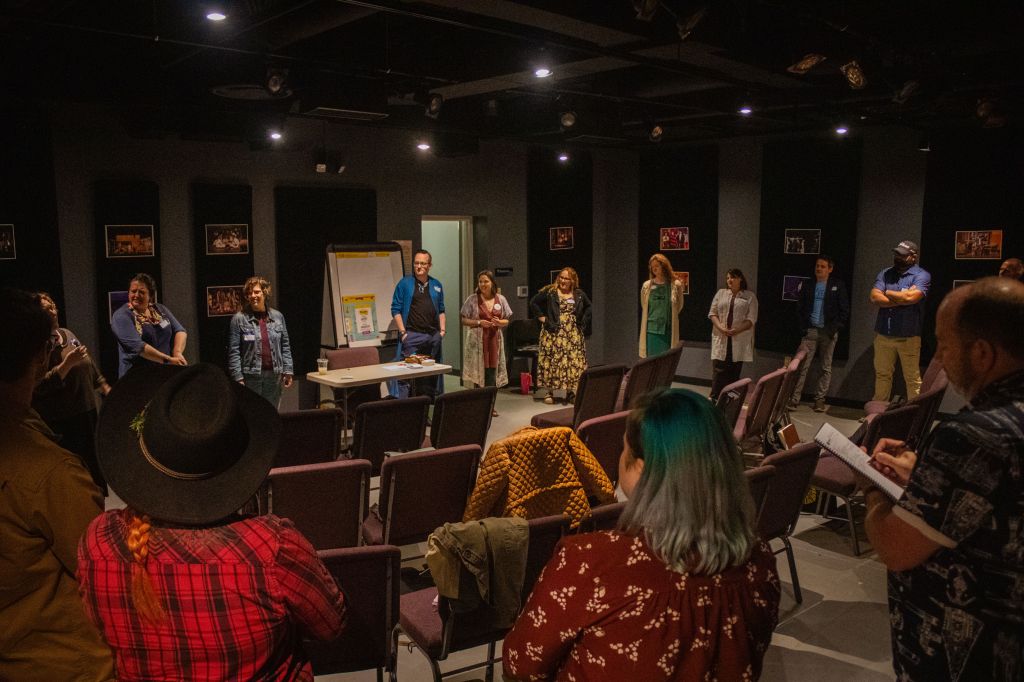
Framework
With that in mind, here’s the general framework of the schedule:
Today is about your story. We will be grounding ourselves in who we are and where we came from. All of the sessions today are designed to give you the opportunity and invitation to both explore and share who you are and what brought you here.
Tomorrow is about our story, what we can create together. The format for most of those sessions will be somebody sharing a tool or experience they have, and then guiding a conversation that explores how that tool could be applied to different individuals’ contexts or advocacy work, and/or people sharing tools that they have used to address similar challenges.
Sunday is a bit of a wild card. I’ve left a lot of open space on Sunday, because it’s about making the story—what is our story moving forward? A lot of it depends on what happens today and tomorrow. We will have a session to bring us together as a group and center us for creative work, and then we’ll have a session where we try to synthesize what we’ve learned and create a strategic plan for moving forward.
Ground Rules
I have a handful of ground rules to help us have a productive and safe and brave experience together.
First of all, every room I run is consent-based, and that applies to this symposium. Feel free to opt out of anything that you don’t want to do. If you’re leading a session and somebody just wants to sit and listen, or otherwise not participate, let them.
Please give credit where it is due. When you’re sharing something with the group, if you learned it from somebody else, we want to know their name. When you leave here, if you’re sharing things you learned here, or we developed together, please name that. I know who is speaking my name in rooms I’m not in, and I also know who is taking credit for my ideas. Most of us who work in the activism space have experienced this. So please treat other people’s ideas the way you would want yours to be treated.
Have grace with each other. We’re all coming from different backgrounds and that means we don’t always have the exact right vocabulary or framing for something that is outside of our lane. Please be kind
I want to state that everyone is a leader, and all of you are activists. When I’m teaching Take 5, I always tell people that, although they might not realize it, someone is looking to them for leadership or guidance, whether they have a formal leadership role or not. Everyone who works in this industry, regardless of their job title, has agency and responsibility to make it less terrible. That’s why this group isn’t just a bunch of artistic directors talking to each other; we’ve got playwrights, actors, designers. You’re all leaders. You are also all activists, any time you make any move to improve working conditions for yourselves or others. You don’t have to be in union leadership or something to be an activist.
Lastly, please take notes. In each session, the first thing that should happen is to designate a note-taker, who is not also the session leader. We’ve got documents set up in the google drive folder that was linked in the last few emails. On Sunday, Corey Holmes is going to help us synthesize the learnings of the symposium, but she cannot physically be in every session, so please help her out by taking good notes. I would also appreciate a brief recap of each of the “thorny questions” dine-arounds. Not that I expect you to be full on taking notes during a meal, but if you could designate somebody to do a brief write-up afterward, that would be very helpful.
Gratitude
I want to close by offering gratitude.
First, to all of you for making this journey. I feel so deeply honored that you are here. Thank you for your work.
Secondly, to Rev Canon Stephanie Spellers, who coined the phrase “radical welcome” in the title of her book, calling on faith communities to really examine whether they are welcoming. Theaters are holy places, too, and have a responsibility to be radically welcoming.
I’m grateful to the leadership at the Wayne, the American Shakespeare Center, Theater at Bridgewater College, and the Shakespeare and Performance program at Mary Baldwin University, for responding to my wild idea with, “Yes. Definitely. This is important work. How can we help,” and for opening their doors and providing space, personnel, and assistance throughout the planning process.
I also want to express my deep gratitude to the many people who wanted to be here, but for reasons of family, work, or distance, were not able to join us. In the past few days, an astonishing number of them have contacted me, just to say, “I’m thinking of you as the symposium is about to begin. The work you’re building is transformative. Keep going.” I feel so supported and encouraged by all of these folks, across the country, who are sending positive thoughts our way as we gather.
 Radical Welcome
Leave a comment